Tuesday, November 3, 2015

Paralympics World Championships 2015 in Doha, Qatar


There was an immediate exhilaration when entering the stadium with 90 flags from different countries at the 2015 World Championships for Paralympics--an opportunity for athletes with disabilities to compete. I am standing with my son who has autism. He too stuns me with his zest and energy for life. Every day he changes my heart, and makes me see things I would not understand without him. 
Ninety countries gathered in Doha, Qatar last week for the 2015 IPC World Paralympics Championships--the last championship before the Olympics and Paralympics in Rio de Janeiro, Brazil in 2016. There were 1300 athletes and 210 events--with 54 world records. China came in first with the most medals, 41, followed by Russia with 24. The UK and US tied, bringing home 13 gold medals. It was touted and advertised as an event that would be "beyond incredible." And it was! I could barely tear myself away from the electrifying exhilaration after the first night that I attended. Cheers and tears were abundant in every section where people from many countries mixed together, rooting for every hero on the field--in dozens of languages and accents. We found ourselves wanting to know about every athlete's journey to this competition. Borders of countries blurred, and the world contracted this week in Doha. It felt like we were all on one united team.

Many of the spectators, like us, with our fully functioning bodies, witnessed a most beautiful, humbling sight as we watched the athletes. The Paralympic athletes elegantly ran, raced in a wheelchair, threw a shot put, discus, or javelin, and high jumped. We saw athletes with disabilities who competed with all their grit and determination--people who had not surrendered to disease, injury, or discouragement. The begging question of the night was: If they so resolutely take care of their bodies and continue to courageously perform, I too can do hard things--feats that may seem insurmountable to me at that moment. Their efforts showed a magnificence of movement, whether they received a medal or not. They gave us a hallowed moment, a memory to tuck away and be remembered again and again.

I have seldom viewed such dignity, resilience, and grace. I felt privileged to be there under the same sky together with them and their families. It was a rare night of celebration to view the indomitable will of the human spirit--the refusal to be conquered or defeated. Watching the Paralympic events was the kind of experience that alters your perceptions, and most of all, your heart. But I  am going to let the pictures tell most of the story.

When I viewed this short video that was shown to advertise the event in Doha, I was transfixed and determined to attend. I did not know about all the classifications for Paralympic athletes, and the rigor it requires to ever get a spot on the team. I am sure your heart will be changed as your watch this short clip about a 13 year old boy from Doha:
Here are the classifications for the athletes that competed in the World Championships in Doha for Paralympics:
ATHLETICS
All disability groups can compete in athletics but a system of letters and numbers is used to distinguish between them.
A letter F is for field athletes, T represents those who compete on the track, and the number shown refers to their disability.
11-13: Track and field athletes who are visually impaired. Blind athletes compete in class 11 and are blindfolded and run with a guide runner. Athletes in class 12 are visually impaired but may choose to run with a guide.
20: Track and field athletes who are intellectually disabled. There are three events for men and women in the London programme - 1500m, long jump and shot put.
31-38: Track and field athletes with cerebral palsy or other conditions that affect muscle co-ordination and control. Athletes in class 31-34 compete in a seated position; athletes in class 35-38 compete standing.
40: Track and field athletes with short stature (dwarfism).
42-46: Track and field amputees. In class 42-44 the legs are affected and in class 45-46 the arms are affected. Athletes in these classes compete standing and do not use a wheelchair
T51-54: Wheelchair track athletes. Athletes in class 51-53 are affected in both lower and upper limbs while T54 athletes have partial trunk and leg functions
F51-58: Wheelchair field athletes. Athletes in F51-54 classes have limited shoulder, arm and hand functions and no trunk or leg function while F54 athletes have normal function in their arms and hands. In the F55-58 classes the trunk and leg function increases


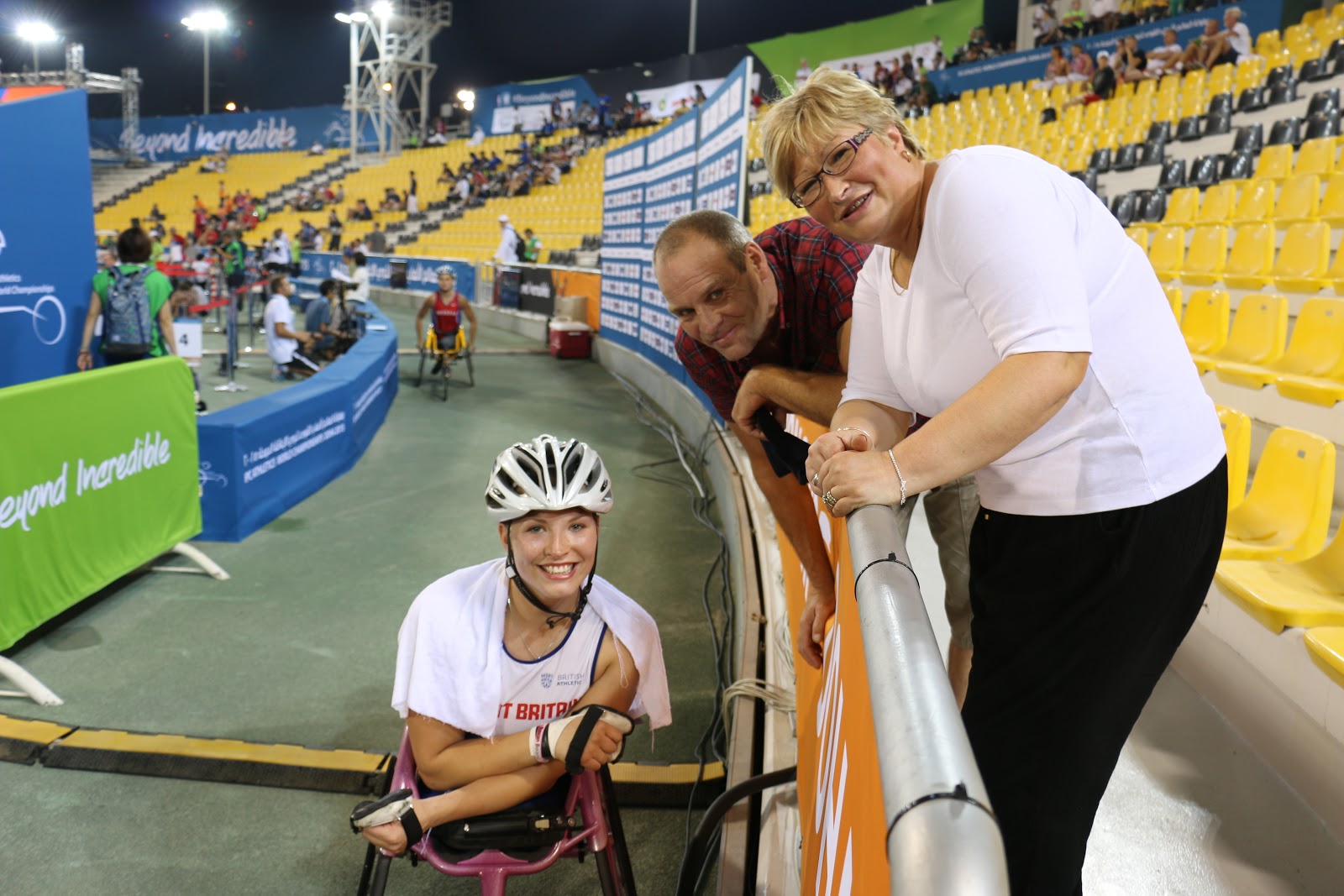
"The Golden Girls," from the UK, with their coach, Paula Dunn. The girls won the T-35-38 4x100 meter relay. This classification means they have cerebral palsy. They smashed the world record in 52.22. Such a proud moment to see these girls and their parents. Unforgettable! 
The Russian relay team for T-35-38. These girls, in my opinion, brought some needed joy to a country that had just heard about the terrible plane crash in the Sinai peninsula. The Russian girls came in second place. Again, so proud!

The Chinese team, who came in third. So proud of each of them.
It was at this moment that I realized that I was cheering for each country, even though I am not from any of them. I cried, with happy tears, for each of those twelve girls on the stage and their families. It was such a jubilant moment.
I stood next to this Chinese couple, the woman who had only part of one arm. Since I speak Chinese, I told her she was very, very beautiful. 
Some Brazilian Paralympian athletes watching some of the closing ceremonies.
The girl in the middle is blind, and ran with her guide who is standing next to her. It was such a privilege to meet and talk with them in my elementary Spanish.
At each medal ceremony there were women in their abayas who carried the medals and flowers on the plates--ready to give it to the athletes.
On the podium for the Men's 4x100 T-35, T-38 relay competition. Germany got the gold.

Gold medal Men's 4x100 relay team T-35, T-38 for Germany. Here they are posed with their coach.


As we looked down from our section, we could see the Men's 100 meter race, with the Women's 400 race for unsighted athletes. To watch these athletes enter the track and field, with their crutches or prosthetic limbs in hand, was a sight we will never forget. The courage and grit that was exhibited in that stadium stirred all of our emotions (and some stray tears) as we watched the human spirit conquer unbelievable feats.
The athletes with the yellow shirts, are the guides for the Women's 400 meter running event. The guides run right next to the unsighted athlete, around the track. There is an obvious, but silent symmetry that unites them.

One of the Women's 400 Meter team, a pair, one is the guide in the yellow shirt, and the other is the unsighted athlete.  Since my father-in-law was blind (he landed on D-Day, and was blinded  six weeks later), my husband and I both teared up at this race. Post about my father-in-law who was blinded: http://trekingonward.blogspot.qa/2015/05/i-might-not-have-sight-but-i-have_28.html The athletes ran together, in perfect balance of proximity and speed-- staggeringly beautiful experience to see.
A team from Africa, one is the guide, and the other is the unsighted athlete.

At the end finishing line, holding hands, the guide and the unsighted athlete.

Paralympic Women's 400 meter events with guide. To see the pairs of runners, with each pair having a guide to aid the unsighted athlete was an experience we will never forget. They grasped hands, as soon as the race was finished.

An athlete in the 200 meter T-54 race 

Many of the athletes wore their country's flag draped about them.

Samantha Kinghorn, 19, from Scotland, with her parents, elated in her bronze finish, for the Women's 200 meter T-54. Her mum told me Samantha was in an accident when she was 14, and lost both of her legs. She trains several hours a day and speaks to others in the UK about her journey. What a smile! So proud of her!
Amanda Kotaja, from Finland, won gold for the Women's 200 meter T-54. This picture is just after her race. T-54 is a classification that means there is normal hand and arm use. There is no trunk or limited use. Isn't she stunning?  https://www.google.com/webhp?sourceid=chrome-instant&ion=1&espv=2&ie=UTF-8#q=amanda%20kotaja

A resolute German athlete after a race.

We were spellbound at the high jump. I will never forget the handsome, young Brazilian high jumper who threw his crutches to the side, and jumped with one leg across the track. He then proceeded to high jump over the bar. It was a portrait of beauty, courage, and grace that will always live on in me.

Another athlete running to get over the high jump.

Such a beautiful sight to see the many people from different countries walking together and cheering each other on.

An athlete from South Africa posing after his race.
One of the signs that were all over the stadium.

A medal ceremony for the winners of a wheelchair race.


The next three shots are of a high jumper that show the grit and tenacity that this event would take for an athlete:

This man has taken off his prosthetic leg, and has proceeded to go over the bar.

Afterwards, I spotted the disappointment in his face that the bar had not cleared, but to me he was a hero.

An adorable UK fan. I have to say the UK fans were in the most abundance.at the Paralympics. A few Brits came all the way for the Championships, even if they had no family in the events. Check out @PaulaJubillee if you want to see more pictures.

Hollie Arnold, from the UK,  receiving her gold medal for the javelin.

Hollie Arnold. running to her mother. to give her a big hug
As soon as Hollie got off the stand or podium, she ran to her mom to give her a long embrace. We were all a tittle teary eyed watching on.

A night to never forget.Thank you to the athletes and their families who exemplify a human will and endurance that will live long with us. Thank you to Doha, Qatar for hosting such a "beyond incredible" event!

Tuesday, October 27, 2015

Proof in the Pumpkin

October has always filled my soul--with the blazing colors of the trees, the expansive fields of bright, orange pumpkins, and the anticipated newness of another season in the air. Just like Anne in Anne of Green Gables poignantly said, "I am so glad I can live in a world of Octobers." One part of the season has always been our pumpkin patch excursions. A visit to a pumpkin patch, with all their unique curves that have been growing for a few months on the vine--the pear-shaped, others more rotund--have always enlivened me.  Last year's post about pumpkins:  http://trekingonward.blogspot.qa/2014/10/our-new-pumpkin-patch.html
After picking the best pumpkin in the patch, the creations can be endless....

My mom at the pumpkin patch with some of my kids,

Obviously, there are no pumpkin patches in Doha, Qatar; it is much too hot here in the desert. I had been told by a knowledgable source that the large orange pumpkins were at a Farmer's Market for about $5 (there are fruits and vegetables imported from Egypt, Jordan, Iran, and other countries around here). Our little family excitedly trekked over to the Wholesale Market. I was definitely not paying the $50 price tag for the curvaceous, orange ones in the grocery stores here. A few of us expats descended at the market--fully expecting to be able to buy some round, cheerful, orange pumpkins--the kind we had always purchased or grown at this time of year. However, it must have only been a small load that came in the week before. There were no orange pumpkins to be found amidst all the venders.

I never thought I would pine over pumpkin patches. They were just always there, just part of every autumn season. But this week I learned a valuable lesson from an improbable source: the pumpkin. I decided that I can enjoy being an expat--when things don't work out as anticipated or hoped for. Indeed, there can be substitutions and compensations that can make us laugh and even enjoy the differences. In our excursion to find the "perfect" pumpkin (or the thing that we have traditionally always had), the search can trigger an adventure, an exploration, new friends, and definitely a chuckle. We came home empty handed with what we had searched for, but nevertheless, happy with a new adventure under our belt.

No one could understand "pumpkins" when I asked around--lots of puzzled faces. They did understand the word "orange" so I was led to the Egyptian stall where they sell oranges. No matter. I bought a small crate of them--you cannot just buy a few. Every morning we have fresh squeezed orange juice, but alas, no orange pumpkins to be found.

On the scout for some "orange" pumpkins. Do you see the men in the background wanting to get their picture taken? Most of the fruit/vegetable dealers are from India, Egypt, and Bangladesh. They love to be in our photos.

This is the supposed pumpkin patch that I found last Saturday at the Farmer's Market--under a pavilion, next to a fish market

Some happy fruit sellers from Egypt and Bangladesh--wanting me to take their picture. It's funny I can tell which countries they are from now--even their personalities give it away. I have found Egyptians to be very playful, funny, light hearted. I immediately knew which one was Egyptian. They are usually making a joke about something--even when their English is minimal. 

Another Eyyptian fruit seller that sold me some pomegranates. He made me laugh so of course, I bought a crate of pomegranates. I just gave some to my neighbors. We can never eat a big box of pomegranates. 

Yay! Finally, we found some opaque orange pumpkins from Iran--not the bright ones I am used to for carving jack-o-lanterns. See them in the box? They come four in a box. But hey, I will take them. Traditions and festivities must go on....

Some friends that we found at the farmer's market, searching for their treasured pumpkins too. Look at the happy faces, even though it is not the typical pumpkin patch we are accustomed to.

The entire time you are in the Farmer's Market they are unloading huge amounts of vegetables and fruit. Here is a cart full of garlic.

Our Bangladeshi "trolley" driver carting our Iran squash (pumpkins), potatoes, pomegranates, grapes,  and "oranges." Not to let the failed attempt to find orange pumpkins dampen our spirits, we just added the trip as one more adventure in Doha.

Across the street is a Fish Market. A fisherman showing off his catch.


So instead of this....

I get this! Sometimes the boys like to dress up in the Qatari native dress. I would be lying if I told you I didn't miss the autumn, but to experience new people, traditions, and cultures can be rejuvenating and enlivening too. So I say the "proof is in the pumpkin" that I can be happy in lots of places. Pumpkins can come in many other different, lustrous colors and shapes.


Friday, October 23, 2015

The voyage of learning the cello

I began playing cello when I was close to 50, and successfully auditioned to be in an orchestra in Doha last year (I think they needed cellists, but hey, I got in). I could liken it to embarking on a very scenic voyage. In these past four years, I have learned many things--not only about music and the cello. I have also met people who have greatly enriched my life--from unfamiliar places like Bulgaria and Yemen. Yet a few times I have wondered why I ever got on the voyage in the first place. And even possibly if I got on the wrong ship?  Occasionally the "musical" waters get deep and tumultuous. But I have resolutely stayed on--even if the waves swirled and tossed me around. Here is a post of 'My Cello Love Story' from almost a year ago that chronicles the reason I ever started cello in the first place: http://trekingonward.blogspot.qa/2015/02/my-cello-love-story.html

Each of the cellists in this section are from a different country.
One of the best things about learning the cello have been my teachers. They have been from all over the world: the United States, Bulgaria, Germany, and Russia. Each of them are uniquely trained, and have not only taught me about the techniques of playing the cello. I have learned other meanings of risk-taking, persistence, focus, exactness, and sheer determination. Today my German teacher said to me in our lesson, "It's not about the tempo. It's about perfection." I had to smile.

My cello teacher, Katrin Meingast, here in Qatar, who directs the Baroque Ensemble and German School music program.
I think I would have got off the ship long ago if it had not been for my first cello teacher. I remember when I was discouraged, she said some very wise words that resonated with me, and now I try to apply it to my life. I said, "I know I am playing 2nd, 3rd, and 4th positions on the cello (I was already familiar with 1st), and I am doing it. But I can't visualize it. I don't even know the notes I am playing." She turned to me, and said, "You know enough. Just keep playing, and everything will fall into place." I can't tell you now how many times I have said, "You know enough" when I am playing the cello and attempting the unknown in other facets of my life.

My first cello teacher, playing some chamber music.
I have been stand partners in my orchestra with cellists from Australia, Yemen, the UK, Columbia, and France. The Australian cellist said to me in the beginning of the year, "There's room for everyone on the bus here." The UK cellist commented, "We have such a good mix here, don't we? (coming from people who have played their entire lives, and even one of them being a professional). I appreciate their patience in me, and their willingness for me to sit on the bus next to them. It makes me want to do the same when I am on other buses with people who are beginning something that I may know more about. As Louisa May Alcott's mother once said, "Encouragement is the greatest teacher."

My Yemen cellist friend came to my house to help me get ready for an orchestra concert. I will never forget him marching around my kitchen while I played, clapping his hands to the complicated rhythm. His English was minimal, and we would talk to each other with his I-Phone dictionary, as he looked up the words in Arabic. We somehow understood each other with the music that we loved and a few common words we knew. If anyone would have seen those teaching moments in my kitchen, they would have roared with laughter.

My Yemen friend  (in the middle) who so kindly taught me more exact rhythm, 
Most of the time last year my stand partner was a 14 year old ninth grader from France. I did not know when I said good by to her at the last concert in May that she would not be back this year. Her family decided to  move back to France in the summer. I miss her. More than anybody, in her quiet, gentle way, she taught me how to play in an orchestra. She would point her bow to the musical symbols, smile at me, nod, and we would whisper a little together. We were unlikely stand partners--probably that you would not see anywhere else in the world. Yet our "stand partnership" worked.

My French stand partner
Playing the cello, I tell people, has allowed me to see some staggeringly beautiful scenery and gone to places I never thought I would visit. But without the fellow passengers who have taught me so much, the journey would not be so grand.

Our holiday concert

Some lessons from the Cello:
1) When you play in an orchestra, everyone, no matter what instrument you play, all tune on the A to begin the orchestra practice each week. Every week as we tune together, I always think that with all our different instruments, nationalities (I would say there are 15-20 in my orchestra), opinions, persuasions, we all begin united--on the same note. This simple tradition or regimen in the orchestra always reminds me that with all our differences as peoples or in even a family, we can find the same note to begin our dialogues. We can even stay on tune as we navigate through our music or in our relationships.

2) Everyone has a chance to shine in an orchestra--not only the violins. Sometimes the harmony comes from the violas, cellos, flutes, clarinets, oboes. In Gustav Holst's symphony, The Planets, a euphonium has a solo. We take turns playing the harmony; in one song the harmony can rotate and switch around to various instruments. We are a group that enlivens the other, and applaud when others have solos or the harmony. We strive for a beautiful counterpoint or polyphony together--the interplay between various harmonies and rhythms. 

3) Sometimes I have to quickly retune--checking and adjusting the strings.  I do not want to be discordant, thus, affecting other's melodiousness. I know that my dissonance can affect the rest of the orchestra.  Just as in life, my mood affects the rest of my family or group I work or reside with. Sometimes I need to pause, check, and get back into tune.

4) Sometimes I play the wrong note, but as my Russian teacher says, "Just keep up with the rhythm, and don't worry about a fumbled note." If I make a mistake, in an orchestra piece or in life, I just get back into the pace or rhythm.   

5) One night our British orchestra conductor, after our feeble attempt to play Dvorak's 'A New World, said, "That sounded very impressionistic." I thought that was a very kind way to say that we were not playing balanced and together. In other words, the notes were blurred, not exact; our playing of that rendition stunk. To find ways to instruct and teach with humor, and not with the sting of criticism, is always the better route. 

6) It is so exhilarating, liberating, refreshing, to learn new things--especially things you never planned on but just came your way. You know enough!!!! 


Thursday, October 15, 2015

Baseball season as an expat

In 2006 when the Cardinals won the World Series, we sported our Cardinal Santa hats. Cardinals fans forever1
Far across the world--nine time zones from St Louis Cardinal Nation, I am in mourning. The St. Louis Cardinals just lost in the post season for the National League Championship to the Chicago Cubs. Yes, even as an expat, living among mosques and emerging World Cup 2022 stadiums here in Doha, Qatar, I am rooting for our team. We are a faithful little enclave of Cardinal Nation over here--never to forget our allegiances. My dear friend, once an expat herself in Malaysia for 13 years who grew up in St. Louis, told me of days getting up at 4:00 am to watch games too. To be a baseball fan is a serious past time. As George Will said, "It is said that baseball is only a game. And the Grand Canyon is only a big hole in Arizona...." I guess I got my baseball fever from my grandpa who always had his small radio to his ear--to hear his beloved Yankees.

Baseball, especially in the autumn, is as important as Halloween or the brilliant, vibrant changes of the season in St. Louis. School almost, and I say almost, closes down, if the Cardinals inch to the World Series. No one thinks much about anything else--work, school, deadlines. If a game is going on, the roads and emergency rooms are mostly empty. Euphoria, celebration, and the deepest of happiness spreads all over Cardinal Nation. Everyone's fears, angst, sadnesses blow away for a few weeks in October when the team is playing its post season games. Baseball is a unifier of all peoples, at least for a few weeks in St. Louis in the post season of baseball. We become kids again--together at a stadium or in front of a screen.

Cheering our team in Busch stadium in St. Louis!


 I have been told that the Cardinal or Redbird nation actually bleeds into ten states, and was Colorado's team of choice until the Rockies appeared in 1993.  But I must reiterate: Cardinal fans do not die if we move across the world. We are still devotees of the highest order, and wear our Cardinals apparel in pride around the markets in Doha. Since we travel a lot as expats, we have found St. Louis Cardinal fans in Paris and Amman, Jordan. You see, we are hearty, resolute fans--always keeping the faith that another win is around the corner--another time to celebrate and unify together. We believe in the mantra, "There is always next year."

Baseball interweaves the past and the present in our lives, and all the "mystical, miraculous moments,"says author John Sexton. I agree. When David Freese hit the unexpected home run in Game #6 of the 2011 World Series, well, those are moments you cannot forget. They are etched in our hearts. https://www.google.com/webhp?sourceid=chrome-instant&ion=1&espv=2&ie=UTF-8#q=david+freese+world+series+homerun  I don't think St. Louis and Cardinal Nation slept much that night. Only one other team, the  Mets '86, came out of the one strike away abyss to win the World Series (I was living in New York City at the time when cars were being turned over in Manhattan, and the whole city was triumphant for a season). As St Louis Cardinal Skip Schumaker said in 2011, "It must have been destiny."" Baseball reminds us there is always hope, always comebacks, always a chance for redemption.

On a Teton river trip with some of my boys--all sporting their Redbird hats.

Indeed, we fans stick together, starting in the spring, to feel that camaraderie, community, and unity on a green field. To share those marked moments with loved ones, with all the history and tradition, is worth all the hoopla. Dancing around with my husband and teenage boys in our living room when David Freeze hit his famous home run are lore of Shumway family history. Need I tell you that I was roused out of bed that night because I had given up hope on the Cardinals?  I saw the famous home run, but almost missed it. Never again. Baseball, the game without a clock, is a game about never relinquishing hope.

That is the reason why we keep coming back for next year--to be a part of a Nation, a community that shares miracles together. But in the meantime, as we are supposed to be happy for others, and I will give a shout out for Chicago who won their against the Cardinals on their turf at Wrigley Field. But again, just you wait until next year.... My hope will never run dry.