Friday, November 18, 2016

Netherlands: Corrie Ten Boom and a life of "Living Faith"

“Today I know that such memories are the key not to the past, but to the future. I know that the experiences of our lives, when we let God use them, become the mysterious and perfect preparation for the work he will give us to do. And our wise Father in heaven knows when we're going to need things too. Don't run out ahead of him.”
                                                           --Corrie Ten Boom


Corrie's bedroom, a small room furthest from the entrance, was "the hiding place." On the bottom shelf in the closet, there is  a lever that could be pulled to enter behind the wall. Bricks were put into place to hide the hole. Nazi informers could not find the hiding place. For three days, four Jews and two Dutch resistance fighters stayed in a small area of 2" X 8" feet. All were set free, but Corrie's family went to prison near the Hague.

Every few years I read The Hiding Place. It is the story of an endlessly fascinating person to me: Corrie Ten Boom, a Christian Dutch woman who was a clockmaker by trade, but helped to save 800 Jews during the Dutch Resistance in World War II. It is a book that resonated with me as a teenager, and in many chapters of my life since then. Corrie was an ordinary woman who resolutely chooses to rescue, to do good--even if it meant the possibility of going to a concentration camp or being beaten by Nazi interrogators. Now decades later, I am the same age as Corrie was when she came home from the concentration camp, miraculously being saved due to a a clerical error. Her decision to not only ostensibly save people, at first her neighbors and then strangers, but then to tell the world how her "living faith" was shaped, continues to move me.

The Ten Boom Museum and Watch store in Haarlem, Netherlands today
A few days ago I was in Amsterdam, Netherlands, and took a short train trip to Haarlem to visit Corrie's home. The first floor is still a watch and clock repair store, with three levels of stairs above the watch business. It was the perfect house for a hiding place; the passages link around like a rabbits's burrow. Corrie's bedroom, the smallest room from the front door, was "the hiding place." Upon entering the floors upstairs, you can hardly not do some soul searching. What side would I have leaned if I had lived in the Netherlands at this time? What choices would I have made? Would my choices be comprised by a "living faith"?


Sometimes when we reread or hear a true story several times, we forget that people made decisions without knowing the outcome of their choices. We, the hearer of the story, know the ending, sometimes in scrupulous, familiar detail. With each retelling, it is embedded more in our psyche. But to a person in a real life setting, where decisions are made with cautious deliberation and fear of danger, the ending is unknown. Important choices are sometimes made in a fog--not knowing when and if the clouds will lift. Corrie's choice to hide Jews and people working in the Dutch resistance, get ration books for Jews, and live a life of commotion and insecurity stir me. With the Nazi occupation in Holland already swallowing any normality or most daily joys, Corrie chose to rescue in very uncertain times. She choose what she believed was good, moral, right--without knowing the ending of her story.

What was the ending of her story? Her 84 year old father died ten days after they were arrested in a prison near The Hague. Her sister, Betsy, whom she loved and revered, died in a concentration camp about two weeks before Corrie was miraculously given her freedom. Some of Betsy's last words to Corrie in the concentration camp where she died were, "There is no pit so deep, that God's love is not deeper still." And then she said, "Go and tell people about what we have experienced, Corrie." Corrie Ten Boom spent the next almost 40 years explaining her "living faith."

Corrie Ten Boom died on April 15, 1983 at age 91 years old. She was born also on April 15. According to Jewish lore, only a tremendously special person is born and dies on the same day.


My Life is But a Weaving 

My life is but a weaving, between my God and me.
I cannot choose the colors He weaveth steadily.
Oft' times he weaveth sorrow, and I in my foolish pride, 
forget He sees the upper, and I the underside.

Not 'til the loom is silent, and the shuttles cease to fly, 
Will God unroll the canvas, and reveal the reasons why.
The dark threads are as needful, in the weaver's skillful hands, 
as the thread of gold and silver in the pattern He has planned.

He knows, He loves, He cares, nothing this truth can dim.
He gives the very best to those who leave the choice to Him.
                              --By Corrie Ten Boom


On one side of the stitching shows all the loose strings, and a matted mess. This was a tapestry that Corrie often shared with others, and liked to see the reaction when she turned it over to show them the other side. (Pictured below)

If you flip the needle work over, you see a glorious crown with a jewel on top. The tapestry she showed often to remind people that our experiences, both painful and joyous, are all woven into our individual canvas. Sometimes we don't know the reason for the delays or sorrows, but someday we will understand the Master Weaver's stitches in our lives.

Monday, October 17, 2016

Children's Art: Candle Light in a Concentration Camp

A twelve year old girl's memories of happier times with her mother

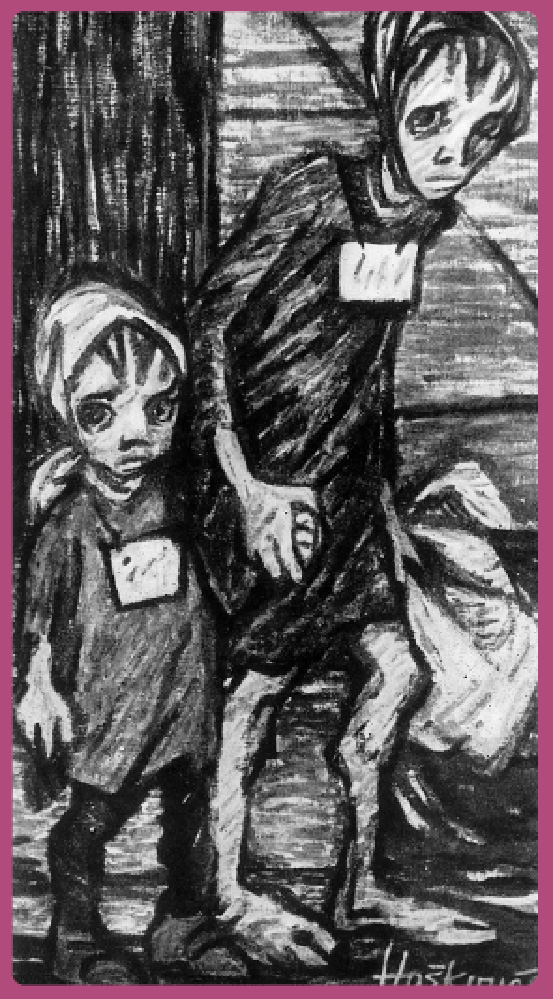
Out of anything that I saw in Prague (and there were plenty of majestic and beautiful places), it was the Holocaust children's paintings and drawings in the Pinkas Synagogue that I will remember the most. I could barely exit the exhibit. To imagine the children, sometimes secretively painting with the precious resources their art teacher, Friedl Dider Brandeis, had brought for them to the concentration camp, left me teary. I couldn't stop thinking about those faces, drawings, and their beloved art teacher.
Most of those children never lived to be adults (about 132 survived from the Terezin concentration camp out of 15,000 children). Their drawings and paintings now witness to us their living nightmares, but also their aspirations and dreams.

The concentration camp, located a short drive out of Prague, was a "model" or "show camp." It served as a way station to concentration camps from the east for mostly Moravian and Bohemian Jews who were on their way to Auschwitz. The Nazis knew that the Red Cross would be inspecting the camp (about 150,000 went through its gates), and promoted Terezin as a camp where education, music, drama, and art was interwoven into their daily lives. Often times bread was exchanged for a class.

The art teacher, Friedl Dider Brandeis, was a well known artist when she entered the gates of Terezin in 1942. She had been mentored by several famous artists of the 20th century, namely Paul Klee and Franz Cizek. In her early training, Cizek had encouraged her to "Show your soul in your art." Decades later, as she painfully searched for paper for the children to draw on in the concentration camp, she also pled for the children to "show their souls." In her own words, Friedl Dider Brandeis spoke of how she taught art to the children, "The drawing classes are not meant to make artists out of all the children. They are to free and broaden such sources of energy as creativity and independence, to strengthen the children's power of observations and appreciation of reality." Later two of her students, Ella Libermann and Helga Weissova, would survive to be famous artists. Years later, Helga said that her art was rehabilitative for her after Terezin, Auschwitz, and an intern camp in Cyprus, on the way to Palestine.

Friedl Dider Brandeis, an artist who some say could have been a major artist of the 20th century had she not been sent to her death in Auschwitz, was intensely passionate about her teaching in Terezin.
In a place of darkness and evil, she believed that the small papers she gathered for the children's canvas and few paints and pencils she had, were tools to excavate imagination and creativity. Erma Furman, who later became a pediatrician, said of Friedl's teaching, "The times spent drawing with her, are among the fondest memories of my life.... She taught without even asking for anything in return. She just gave of herself."

When Friedl knew she would be deported to Auschwitz, she gathered 4,500 of her student's drawings, and hid them in two suitcases. Now these paintings and drawings hang in the Jewish Museum of Prague, the Pinkas Synagogue in Prague, and the United States Holocaust Museum. Some of the drawings were later used at the Nuremberg Trials. Little would she ever know, that those simple drawings from children in a concentration camp would be their stories, even the world's stories. She was an illuminating, blazing fire in a place of pitch darkness.

  Friedl Dider Brandeis (1898-1944) was an immensely talented and even acclaimed European artist when she entered Terezin, the Czech concentration camp. Her design of stage settings, lace, and textiles were well known. Later she painted landscapes, and taught the children of Terezin art lessons. Today she is most remembered for her courageous legacy of teaching art/art therapy in the Terezin concentration camp.  
One of the suitcases that transported the children's paintings and drawings....

A more whimsical image of a child who had seen a theatre performance in Terezin. It is interesting that the fireflies are what captured her imagination--light. She was probably trying to absorb some light in a place that was void of it. 
A child's fantasy return to Palestine
An unknown artist's drawing of "Girlfriends"
A twelve year old's vision of "The Tree of Knowledge" It makes you wonder if she felt the world was hiding some knowledge that he did not know about or craved to know.
Alfred Kantor. 17 years old. He wrote about this drawing:  “Touch the wire fence meant instant death. However, people shared bread, a smile, a tear…”. Terezín.
alfred_kantor
.

Helga Weissova. 13 years old. Drawing titled “Terezín arrival”. Helga entered in the concentration field with just 12 years old. She brought a box with paintings and a notebook. She draw more than 100 paintings doing what her father told her: “Paint whatever you see”. Here ended Helga’s childhood. With the responsibility of painting everything she saw and experienced. She was one of the few survivors.
helga_4
.
Helga WeissovaThe last drawing of her series, made at Terezín’s exit in 1945. Everything can be sensed in the children’s look.
helga_6
.
Yehuda Bacon. Being 16 years old he drew this portrait of his father recently gassed and burnt at Auschwitz. The face of his father emerges emaciated through a curtain of smoke.
bacon

Tokyo Fuji Art Museum founder, Daisaku Ikeda, who was instrumental in bringing the exhibit to Japan, stated, " The various artworks left behind by this great woman and the children of Terezin are their legacy to the present, to all of us today. They demand that we continue in our quest for a society that truly treasures human life, transcending all differences of race, religion, politics, and ideology. It remains my heartfelt hope that this exhibit may provide a moment of introspection for its viewer, a moment for us to reaffirm the importance of our rights as human beings and the value of life itself."


Friday, September 23, 2016

Learning to Walk Again

An early morning walk is a blessing for the whole day.
                                                  --Henry David Thoreau

I don't remember learning to walk as a toddler. It is just one of those predictable stages of development we all learn to do. But I can remember each of my children's first steps, and the excitement for them to have a vertical perspective on the world. Walking is an ordinary, common thing we do every day... until you can't take any steps anymore.

This summer on a a carefree, blissful day of fly fishing (on my husband's birthday, no less), I slipped on a gravel incline. I was not paying attention, you know multi-tasking--talking to my daughter on the phone about her upcoming wedding. The thoughtless fall turned into an injury that reverted me back to seeing the world in a horizontal position. Yep, sitting in a chair, with an elevated leg for a month. I broke my ankle, had a steel plate and nine screws put into my leg, and saw the summer pass, looking out the window. I kept telling my impatient self to take the long view: read some books that had been on my list for awhile, write, work on my parent's life histories, play the guitar and serenade anyone roaming around "my chair." I lovingly welcomed any visitors who wanted to come to me (because I was going nowhere to see anyone). I also begin to knit again.

Lots of sitting this summer in the "throne chair." It was more bearable with loved ones coming to knit, play games, laugh, and sing with me.
One of my friends said that "Mending bones=knitting them together again." I took her insight literally, and sat there in my chair, imagining my bones healing. Clicking the knitting needles together made me literally take my predicament in my own hands. If I could knit a long scarf, lengthening the latticed stitches, then maybe the fractured bones would simultaneously link together too. From my courtly chair, I even taught some of my nieces and nephews to knit. We all all sat in the room, clicking the needles, talking, laughing. The audible sounds of the needles coming together gave me hope that my bones would heal--that they would not stay indefinitely unravelled.

As I sat there with occasional throbbing pain, I promised God I would be a better person if I could just walk again. I would walk the walk, not just talk the talk. I would climb higher peaks, and view more expansive views. I would walk forward, step by step, on better, more productive paths. Suddenly, my range of motion and mobility meant everything to me--something I had always just taken for granted since I was a toddler. But no more.

Signing the cast was fun--a walking around souvenir of my injury.
Walking takes us places to where we need to go physically, but also in our heads. As Thoreau said, "I took a walk in the woods and came out taller than the trees." I have been reminded, sitting in the horizontal position for so long, that not only my body craves a walk, but my mind needs those steps too. I feel like a person who has been blind for two months, and then can see the light and colors again. 

I vow to walk in terrains and paths that I previously thought were inconvenient or didn't think I had the time to go. Maybe even some roads I was fearful to tread. I will try to even step up the pace or gait of where I know I need to walk--turn the corners more willfully. I will notice the seasons,  the trees and sky more, not just pay attention to my watch. As Soren Kierkegaard said, " I have walked myself into my best thoughts." So this right foot (and ankle) will go to more and better places. No more delays on route. 

And yes, two months later, I did dance the night away at my daughter's wedding with a very stylish big black boot from my orthopedic doctor. Believe me, I was so grateful to be on the dance floor!


Enjoying (on my boot) watching my daughter and husband dance at her wedding.

Lessons from learning how to walk again:


1) One of the best parts of being on the injured list is that people come to you. I almost felt like I was in a Jane Austen book because people would often come to visit or "call." Every visit cheered me up a little more, encouraged me. It reminded me how the simple tradition of visiting can lift someone when they are ill or injured. I vowed to visit more in the future and have more compassion--when friends and family are home bound. 


Kayleen, my friend who came to visit, who I had not seen in several decades.


Visiting my friend on my scooter who has been sick. I could not get there fast enough to see her, knowing that she had been very ill this summer. We both laughed because I had to literally crawl up her front porch steps to see her, and then pushed the knee scooter up. Ha! But again, I will do everything I can to go see people who are sick now.
2) Don't spiral into discouragement. Receive the service you are kindly given. It is definitely humbling to be helpless and dependent, but take the time to let your body heal.


3) Get your body strong again. Be grateful for every person who wants to help you--advise not easily followed! Exercise those muscles that have been languishing, while letting the bones heal. Listen to your physical therapist, and do your exercises!


4) Bones and stitches can heal on their own if we are patient; our bodies are miraculous. But a broken heart requires others to succor so it can heal. Grief and sadness requires a real friend to mend a broken heart. I want to be more aware of the invisible "broken," struggling souls around me who need care and encouragement, despite no outward appearance of injury. I used a wheel chair, a knee scooter, and crutches, and was even able to use a handicap parking space. But my broken ankle reminded me there are people who have injuries that are not obvious to anyone else. I could only hope to be a little more perceptive and aware of the hidden needs of those around me. 


Friday, August 26, 2016

100th Anniversary of National Parks: May our Paradise Never Be Lost....

"This something we call America lives not so much in political institutions as in its rocks and skies and seas."                                                               --Paul Strand, American photographer

A year ago, on a short flight from Boston to Washington D.C., my daughter struck up a conversation with a man sitting next to her on the plane. After some minutes of conversation about our National Parks (since he was wearing the seal on his jacket), she asked him if he was a ranger. "No," he answered, "I am the director of the National Park Service. My name is Jonathan Jarvis. But yes, I started out as a park ranger in 1976." Since she descends from a family who crisscrossed the country in a rumbling family van to visit national parks, battlefields, and other historical sights from her infancy, he could see her passion for the land he loved too. She said he spoke of the immense treasure we have inherited in America, and how we must be advocates for all countries to protect their cultural and historical heritage. Our national parks do more than inspire. The mountains and seashores, gifts from a benevolent God, give us fuel to be better humans--better caretakers of not only our earth, but future generations. They have been lovingly bequeathed to us, and we must in turn, love and protect them.

This week marks the 100th anniversary of our national parks, iconic landmarks in our country's Treasury that belong to each of us, whether we are rich or poor.  Each is a place of pilgrimage for the soul. Many think a remotely known artist named George Caitlin was the initial spark for the national park idea. In 1832 he wrote after visiting some Indian territories in the West, "By some great political policy of government... in a magnificent park, containing man and beast, in all the wildness and freshness of their nature's beauty." Perhaps Caitlin envisioned only one park, but his idea has blossomed into 450 national historical, recreational and cultural areas. The National Park Service comprises not only parks, but monuments, memorials, military parks, historical sights, parkways, seashores, and river ways. Indeed, we are a rich people of immense fortune.

With an artist's love for the world and its beauty, Caitlin began an American dream that has been fostered now for almost two hundred years. With various trappers, writers, artists, naturalists, and entrepreneurs visiting the West in the mid-19the century, Yellowstone was signed as a National Park in 1872 by Ulysses S. Grant. In 1906 President Roosevelt signed the Antiquities Act to protect monuments, caves, and other natural treasures, the first one being Chimney Rock in Wyoming. One decade later, President Woodrow Wilson would sign on August 25, 1916 the beginning of the National Park Service.

One of my favorite presidents is Teddy Roosevelt, known as the Conservation President. But exactly what were the pathways that forged the man that said, "I have always said I would not be president had it not been for my experience in North Dakota (or later known as Badlands National Park)." When Teddy's young 22 year old wife died two days later after their first child was born and his mother died the same day, he teetered between despair and hopelessness. On the day Alice died, Theodore made a large X on the page, and wrote only, "The light has gone out of my life." When he wrote her obituary, he wrote, "And when my hearts's dearest died, the light went out from my life forever." Badlands rescued, changed him. When he went out West to North Dakota to summon his spirit again, the vast openness gave back his life. The boundless prairie, with mostly prairie dogs, instead of people, and the wide, open skies, revived him. The meadowlarks and owls that called from lone trees in the wilderness changed his melancholy despair to happiness again. Later Teddy Roosevelt's grief would be eclipsed, and he would say, "Life is a great adventure. Accept it with such a spirit."

As we enter now a new chapter of protecting our earth from climate change and pollution, we must remember the precious inheritance we have been given. Our earth gives us a sense of place and beauty. But it does more. Mountains are pinnacles and cathedrals in the sky. Rivers and seas wash grief and confusion away. A canopy of bright stars awakens us to new levels of awareness and reverie. Canyons can chisel our fears, shaping us into a new person. A gentle wind can blow new life and enthusiasm into our soul. The routes our souls have taken in the topography of our lives gives us boundless blessings--enriching not only our own souls, but our relationships. Landscapes can shift our fears and misgivings to joy.

Whether we know it or not, the land, revitalizes our spirits. It is God-given, and more necessary than we would ever know. A rippling wind on a grove of quaking aspen trees in Grand Teton National Park allows me to enter a portal of heaven on earth, a place I would never know if it had not been sequestered, protected. May we bring heaven too to all those who follow us by protecting the earth we we born on. It is our duty when we have been cradled in uncommon beauty for so very long.

Happy Birthday to every national park and monument! Thank you for transporting me to the miraculous, the soul-saving--every time I meet one of you. I have been to many of your Treasury, and I will roam and climb until I have seen each one of you....

This summer in my favorite National Park--Grand Teton National Park. Here is a blog from last summer why I love the Tetons so much: Teton Tales 

My daughter and I in Canyonlands National Parks a few years ago. The Southern Utah National Parks have filled me with wonder and awe since I was a child. For one month I knew their topography when I roamed for one month as a teenager there in a BYU survival program.

My daughters in Zion National Park--on a trip with their father.

My husband climbing in Yosemite with my son. Peter was only 10, maybe 11, but he has always spoke of the bonding that happened with his dad on the spires of Yosemite

The three Tetons, an endless fascination for our family with the land. My husband's grandpa helped to conserve the Grand Teton National Park in his jobs with the Department of Interior.

My children joyfully hiking with their dad in the Tetons....

A few years ago hiking The Narrows in Zion National Park. I wrote a blog called Chasing the Light

Saturday, July 30, 2016

Family Time in the Dining Room

When you have lived in a beloved home for almost twenty years and have left its cradling walls, sometimes your mind returns on what happened there. What exactly were the daily lessons we all learned from one another as we raised our children (and ourselves)? As I look back to the rooms of that wonderful home, I have to say the dining room is where most of the mentoring was done. Blogpost about our home called: RIP Bridge Haven, our old home I don't think I realized it at the time, until now a few years later, but our ideas had more purposes than I knew.

When I was much younger, I read the quote by J. R. R. Tolkien that describes a hobbit house. I secretly wished to make it into a home like Bilbo Baggins, "It was a perfect house, whether you like food or sleep or storytelling or singing or just sitting and thinking best, or a pleasant mixture of them all. Merely to be there was a cure for weariness, fear, and sadness...." When we lived in our first apartment in New York City, I decided to initially tackle the furniture. I wasn't sure how furniture would transform it into a house that drew storytellers and singers. But I opted to try...

The first piece of furniture we bought in our marriage was no other than a dining room table. We both decided we wanted to entertain as much as we could--even with our meager budget. Since we both came from large families, the notion to regularly invite others to our table sounded satisfying, cozy. We found a 1910 long oak table in New York City where we lived, the kind you lengthen by pulling out each end. Often we would stretch both our budget and our table to fit 14 or more people at the extended table. Sometimes people would bring dishes too, presenting many treasured memories in those early years of our marriage. That table brought lively, peppered conversations, developing bonds of relationships that still reverberate today. I thought then our worthy endeavor to entertain and invite had been realized.

The experimental round table in our dining room.

Since the long, corridor kind of table was pleasant and inviting to me, I was surprised when my husband came home about ten years later with a loftier idea: to make a round table. His devised plan? To cut two semi-circles out of plywood, join them together, and give it a lavish stain and varnish. The table would be about eight feet across, fitting 12 people comfortably. He thought we could just put the new round plywood circle over our old trusty rectangle table, providing a way to increase lingering conversations with our tween children. Eventually, we had six children, plus his father who lived with us for almost seven years. His round table brainchild was just one more experiment in how to raise kids. I decided to go along with his design of the table. What could we lose? Hadn't King Arthur and The Round Algonquin Table in NYC benefited from a round table?

Here is a picture at Christmas with the Boxing Day crowns on, one tradition during the holidays. On this particular holiday, from Thanksgiving to Christmas, I draped a canvas painting tarp over the table. During that entire holiday, everyone wrote down their blessings on the canvas fabric. We used it as a tablecloth for awhile, reminding us of that particular holiday. Later it became an expansive picnic tablecloth...


For a while, after my husband set up the round table, he quietly measured how much time the kids would linger after meals. He would smile contentedly to himself at how long people stayed at the table--not wanting to rush away to leave the conversation. No words were said, but I think even he was a little surprised how well his undertaking had succeeded. When we invited guests to dinner, the same result happened; people more naturally conversed, laughed, joined in on jokes. There was a natural magnanimity to the round table, with no hierarchal placement. Everyone faced one another, with equanimity. My husband was right: his experiment with the shape of a circle for our dining room table worked marvelously. I can even say that plywood wooden table changed the dynamics of our family. 

After a few years, I made this large "lazy susan" that twirled around in the middle of the round table. I wood burned some of our favorite family sayings, watercolored the wood, and then glazed it. Again, there were not a lot of words or reminding, but these simple family quotes reminded my kids that our family could do hard things, like their grandpa always said, "Do the difficult" or their great-grandma said, "Cherish your dreams." The quotes were always there in the middle of the table to encourage, maybe even instruct. Every night we would light some candles during dinner. I think the dripping of wax on the candles signified that while we were all together, it was a sacred time. When we blew out the candles and went our separate ways, then our time had elapsed. But while we were there, with the flickering lights at our table, that time was all ours. 

The symbol of a circle means completeness, with no gaps or breaks. To know that you will ultimately gather every day, looking across and rubbing elbows with those people that share your walls, gives an increased desire to connect. Maybe even reaching out to make any wrongs be made right since the last time the circle gathered. That table was where children were quizzed for an upcoming test, played games, and sat with their grandfather. I remember many significant family discussions at that table too, one being when we thought of moving to another city. I don't remember the vote, but my son told me the ballot box came out and we voted on a possible move. Again, the round table brought consensus, unity, and understanding--if there were ever any breaks in the circle. 

Another piece in the dining room was a little more discreet, perhaps even silent most of the time, but it was our "Family Mission Statement." It hung above the round table, a document that was edited for three years before it ever made it to the wall. Each of us, with unanimous consensus, signed that agreement (I won't publish it here because your family can hash out and revise their own if they wish). But oftentimes, I would look at the wall above the round table, remembering what we all had agreed to do--to love one another, no matter what. To have fun, support, and encourage one another. 

A few years later, I peeled off some pictures that were hanging on one wall and decided to paint my own version of a family tree. My friend and I painted the tree one afternoon. I love storytelling, especially the family history variety, and well, with the ancestor names on my dining room wall, wouldn't their stories beg to be told? 


Here is the tree, in all it's glory that spanned our dining room wall for many years. You can see it was not painted with a true artist's eye, but the names (the branches had my kids' names on it), with the trunk filled with ancestor's names. I liked the idea that the roots had the ancestors' names on it, signifying where we all came from. The fact that tree bark can be several inches thick signifies that it protects the tree from fire and disease. I always felt that tree, with all the ancestors' names on it, shaded us, protected us.  

I liked to think that both my husband and our Icelandic, French, Swedish, and English ancestors enjoyed the notion that their names were on our dining room wall--sometimes several hundreds of years after they had died. If anything, the tree provided a canopy of wisdom and goodness, with some of their stories.

Within the boundaries we live in our homes, they are the bridge to our inner and outer worlds. Undoubtedly, the rooms and walls that we live in distill memories and wisdoms that linger with us forever. They prepare us to journey on, to find courage, to learn how to meditate, and more than anything to love without borders and divisions. I would say in unlikely places, such as tables, chairs, and with a candle's glimmering brightness, people are grown--the old and the young, the small and the tall. The special rooms of our lives will always open to us wherever we rove, reminding us of things that were taught to us within its walls. Memories of home cushion and fuel us to do hard things, just as Bilbo learned: "The road goes ever on and on, down from the door where it began. Now far ahead the road has gone, and I must follow if I can."                             


Monday, July 25, 2016

The Poetry of Barns

In front of one of my favorite barns, a place that has taught me woodworking. It is a place of immense creativity and camaraderie.
Here are some iconic barns, a part of Mormon Row, in front of the Tetons in Grand Teton National Park in Wyoming. In the 1890's a group of 27 homesteaders clustered in these pastures in front of the majestic Tetons. Now visitors come from all over the world to view the much photographed barns, remnants of an earlier frontier history in the Jackson Hole Valley. The area is called Antelope Flats.

All of my life I have had a fascination with barns. I love every variety--the tilting roofs with bare scaffolding that show every patch of weathered vein in the wood. You know the one that looks like it is slumping, crumbling, begging for a new friend--the kind I crawled around as a child. The spacious, light-filled beams in other barns can resemble a nave in a cathedral, giving awe-struck, even reverent moments and revelations. Sometimes, if we listen long enough, a barn can unravel long-held secrets. Like people, they have personal traits and characteristics in their spaces that are unique to them. No barn is the same. They each have a purpose to their story--whatever their anatomy.

Barns are a symbol of someone's heritage, their life choices, opportunities, and what they reaped. They are a reservoir to store precious livelihoods, keeping animals that allowed them to retrieve their harvest. Both mammoth and small barns were made with keen design and skill, and attention to every joint and nail. As my boys dismantled an old barn this summer to retrieve the beautiful reusable wood, my son commented, "I was amazed at the arduous work that I could see someone had done eighty or so years earlier. As we pulled out the long, rusty nails, I could see the care someone had taken to build their barn. I wanted to preserve as much as the wood that we could for the next chapter in the barn's life--to make an art barn." Indeed, they knew they were in a special territory, where some unknown people had sacrificed and toiled. It only seemed right to gather as much as they could to use again.


My son, Elias, who has been helping to make an art barn this summer.

Part of the work team to dismantle "the old barn" that will now have a different purpose: to fuel a desire to create with art. The windows, some that will have access to a loft, will have views that inspire painting, writing, and sculpting.


Dismantling the old barn
Gabriel Deerman, an art instructor who changed our lives with his attentive interest in my son's art work (Elias, my son,  has autism). We all became kindred spirits when I heard of his dream to renovate two barns on his property between Toronto and Montreal, Canada. He is building art studios for he and his wife, and will offer art workshops in the Tamworth, Canada area. Here are two posts I wrote about him and his future art studio and classrooms: Fostering Creative Collaborations and I want our house to smell like art  Here is more information about Gabriel's barns turned studio/classrooms: Salmon River Studios

Here is another famous barn in Heber Valley, Utah, called the Tate Barn. It is located just below Soldier Hollow, where there was the cross country runs for the 2002 Olympics.

Barns are typically rooted in seasons of harvest, tending animals, and family celebrations. But they are also monuments to strong people who were resilient in long ago storms. Like the joints of wood that solidly bind barns together, they connect us to other times and tales. Barns can attach us to groves of trees, meadows, fields, and rivers that are hallmarks in our hearts. With their soft moans and howls on icy nights, barns shelter us. On summer days with the sun glistening through the shadows, they make us feel safe, and at home within their walls. Barns allow the smells, sounds, and close proximity to nature that most homes cannot give. They are a link to the land, that all of us crave, whether we know it or not.

Several years ago we thought we might relocate to upstate New York, and I began to search for a new home. The reason that I fell in love with a property outside of Rochester was not the 1820 house, but you guessed: it was the beautiful barn on the land. As I roamed through that renovated barn, I could envision lively Halloween and Christmas parties, with plays and music with friends and family. The empty stalls seemed perfect hiding places for frolicking children. But it was not to be. We did not move to upstate New York. But other barns have kindly compensated--to inspire me with beauty, friendship, and creativity. My circle of relationships have been widened, as I remember and am linked to the people who toiled within the barns that I love. 

An old weathered barn, one who has known many seasons, invites you to enter his past. And as you come in, an old barn can whisper true tales--not only evoking former days, but infusing a deeper sense of history, a desire to create, a love of community.  I believe everyone should have at least a few memories in a barn. Never underestimate the power of a barn.


A barn dance, with people of all ages, enjoying a square dance.


A wonderful friend and artist, working in a barn. He is describing to some young people the correlation between clay and The Potter in Isaiah 64:8. The scripture reads, "But now, O Lord, thou art our father, we are the clay, and thou our potter, and we all our the work of thy hand."
A barn can be a place of immense creativity. The paintings of nature on the wall, the woodworking, and in another corner is where artists can create pottery.

It's satisfying to get out and work in the fields--to get away from 21st century distractions.


A pumpkin farm in upstate NY.  Barns just naturally go with autumn.
Being part of a barn dance this summer. These young women spontaneously put together a barn dance, providing the music for the gathering. It was a night we will all always remember, maybe because it was in a barn?
A horseman friend walking from the barn, preparing to saddle his horses. The scene reminds me of a poem that invites us to a more simple life:

I'm going out to clean the pasture spring;
I'll only stop to rake the leaves away
(And wait to watch the water clean, I may
I shan't be gone long--You come too.

I'm going o.ut to fetch the little calf
That's standing by the mother. It' so young
It totters when she licks it with her tongue,
I shan't' be gone long--You come too.
-- Robert Frost